Quick answer
For the Voodoo Child (Slight Return) riff, use your Line 6 HX Stomp as a pedalboard in front of your amp with two blocks: the Teardrop 310 wah (Mix 100%, Level −6 dB) into the Arbitrator Fuzz(Fuzz 8, Level 7). Play your Strat's neck pickup and rock the wah with an expression pedal.
These are Tonafy's settings for a Fender Stratocaster into an HX Stomp and a Fender Blues Junior. With a different guitar or amp, Tonafy adapts them to your gear.
Step by step: set up your HX Stomp for Voodoo Child
- Run the HX Stomp into your amp's input and leave its amp and cab blocks out of the patch.
- Add the Teardrop 310 wah as the first block: Mix 100%, Level −6 dB.
- Add the Arbitrator Fuzz right after it: Fuzz 8, Level 7.
- Assign the wah's Position to an expression pedal (start around 40).
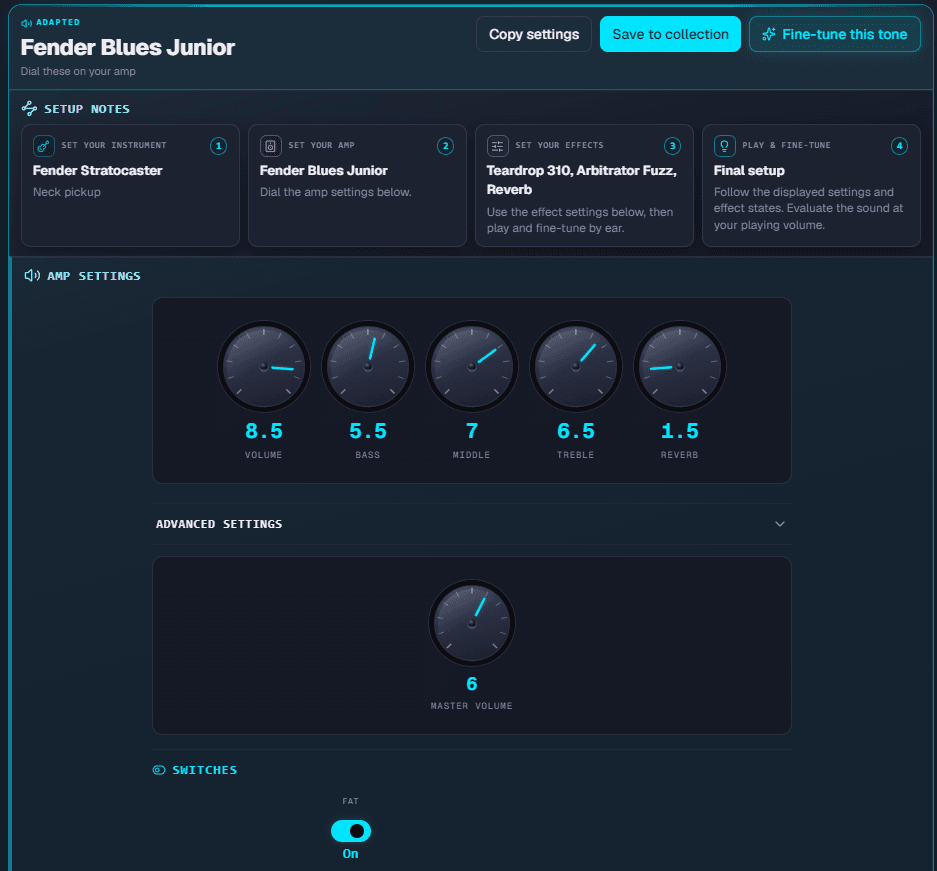
- Set the amp: Volume 8.5, Bass 5.5, Middle 7, Treble 6.5, Master 6, Fat on, Reverb 1.5 or off.
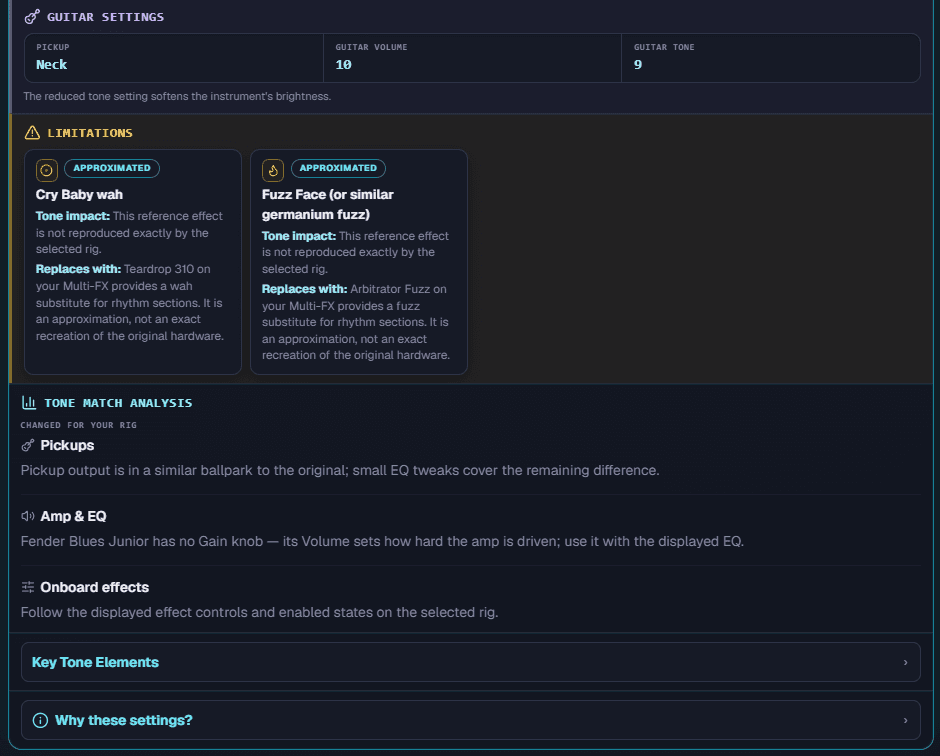
- Select the neck pickup, guitar volume 10, tone 9, then play the riff and fine-tune by ear.
What Jimi Hendrix used on the original recording
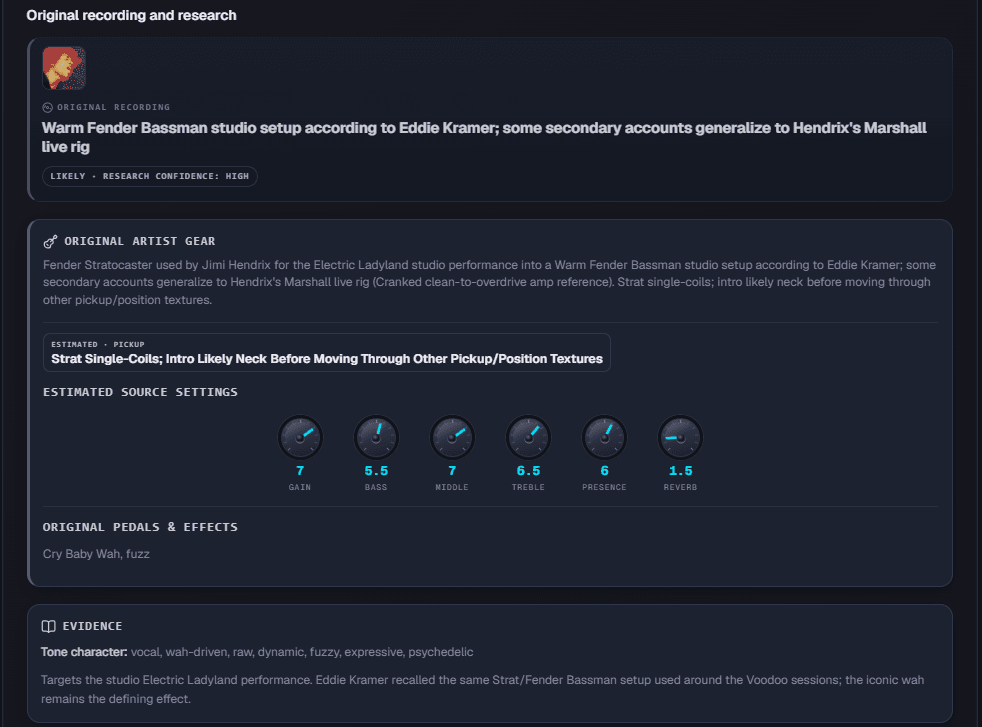
Voodoo Child (Slight Return) was recorded at the Record Plant in New York in May 1968, with Eddie Kramer engineering. Tonafy's research points to this setup. The guitar and effects are well established; the amp is debated:
- A Fender Stratocaster with single-coil pickups
- A wah pedal as the defining effect (a Thomas Organ/Vox design, sold in the US as the Cry Baby)
- Fuzz Face-style fuzz for the saturation
- Amp: reported as a Fender Bassman in the studio, though other accounts describe his Marshall stage rig
The character is vocal, wah-driven, raw and fuzzy. That's the target the HX Stomp and amp settings below are built around.
Line 6 HX Stomp settings for Voodoo Child
This is the main riff (Tonafy's “Riff” part). Both blocks are required, in this order:
| # | HX Stomp block | Settings |
|---|---|---|
| 1 | Teardrop 310 (wah) | Mix 100% · Level −6 dB · Position 40 |
| 2 | Arbitrator Fuzz | Fuzz 8 · Level 7 |
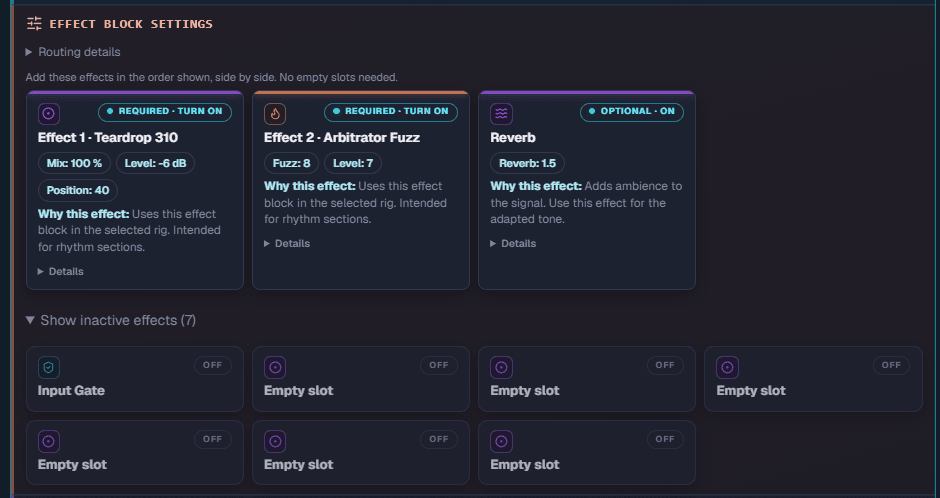
The wah's Position 40 is a starting point, not a fixed setting. Hendrix moves the wah constantly, so put Position on an expression pedal and rock it with the rhythm. The fuzz runs high (8) with its output at 7, so it adds saturation and push into the amp.
Amp and guitar settings
In this example the HX Stomp feeds a Fender Blues Junior. It has no Gain knob: its Volume sets how hard the amp is driven, balanced against Master.
| Control | Setting |
|---|---|
| Volume | 8.5 |
| Bass | 5.5 |
| Middle | 7 |
| Treble | 6.5 |
| Reverb | 1.5 (optional) |
| Master Volume | 6 |
| Fat switch | On |
- Pickup: neck
- Guitar volume: 10
- Guitar tone: 9
Using the HX Stomp as your pedalboard
Many players use the HX Stomp as a compact pedalboard in front of a real amp rather than as a full amp modeler. That's how Tonafy sets it up here: the HX Stomp supplies only the wah and fuzz, and your amp supplies the amp tone. Tonafy lists the blocks in the order to add them, one after another, with no empty slots in between.
Because the amp has its own reverb, Tonafy keeps reverb on the amp and leaves the HX Stomp's reverb out, which saves a block for the effects that matter for this song.
Common mistakes
- Parking the wah. A fixed Position sounds like a filter, not like Hendrix. Use an expression pedal and keep it moving.
- Adding the HX Stomp's amp and cab blocks. In front of a real amp they stack a second amp sound on top of yours.
- Changing the block order.Tonafy's settings assume wah first, then fuzz; swapping them changes how the two react.
- Defaulting to the bridge pickup.The research points to the neck pickup for this part, and Tonafy's settings are set around it.
- Expecting an exact copy. The record was made with 1968 amps, microphones and studio processing. Aim for the character, then adjust by ear.
How Tonafy adapts this tone to your rig
Tonafy starts from the researched original tone, then works out settings for the gear you actually own. Here it matched the original wah and fuzz to the closest HX Stomp blocks, set the Blues Junior's volume and EQ around them, and chose the neck pickup.
Choose your own guitar, amp and multi-effects unit, and you get settings for that exact combination. You can also see the Voodoo Child original tone and amp settings, see another multi-effects setup in the Come As You Are POD Go guide, compare amp-only setups in the Enter Sandman and Sweet Child O' Mine Boss Katana guides, or read the guitar tone finder guide for the full method.
Voodoo Child on an HX Stomp: FAQ
Which HX Stomp blocks do I need for Voodoo Child?
Two: the Teardrop 310 wah first, then the Arbitrator Fuzz. In Tonafy's result for this rig, both are required; every other slot stays empty and the input gate stays off.
Do I use the HX Stomp's amp and cab blocks?
Not in this setup. Tonafy treats the HX Stomp as your pedalboard in front of a real amp, so only the effect blocks are used and your amp provides the amp tone.
How do I play the wah part?
The Position value of 40 is only a starting point. Hendrix rocks the wah throughout the riff, so control the Teardrop 310 with an expression pedal and move it with the rhythm.
Which pickup should I use?
The neck pickup, with guitar volume at 10 and tone at 9. Tonafy's research points to the neck pickup for the intro, so treat it as a likely choice rather than a documented fact.
What amp did Hendrix use on Voodoo Child?
It's debated. Tonafy's research points to a Fender Bassman in the studio, while other accounts describe his Marshall stage rig. Neither is confirmed by a primary source we could check, so the Blues Junior settings here are a starting point, not a copy.
Will this sound exactly like the record?
No. The record was made in 1968 with different amps, microphones and studio processing. These settings get you the core wah-and-fuzz character on your gear; fine-tune by ear.